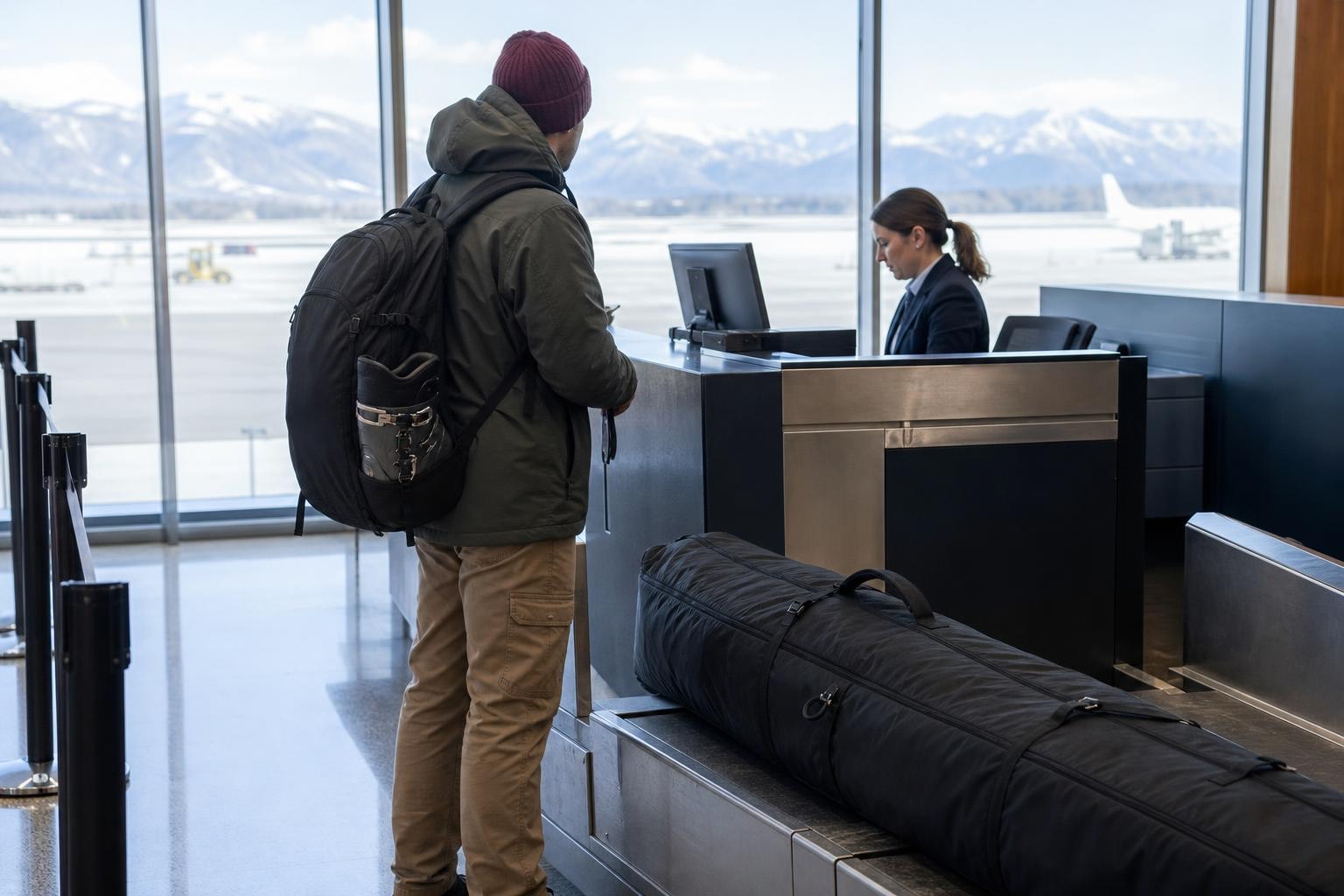
Most skiers who fly check one long ski bag and carry their fitted boots on. You pay extra when the boot bag counts as a second checked bag, the pair goes over a weight limit, or your fare doesn't include a checked bag.
Below are the published rules for six major U.S. airlines: American, Delta, United, Southwest, Alaska, and JetBlue. We checked the Delta and Southwest pages again on November 11, 2026; the other linked airline pages were checked October 24, 2026. Fees are for U.S. domestic flights where the airline publishes one. Your route, fare, status, credit card, booking date, and partner airline can change the price.
Airline ski bag policies and fees
Sources: each airline's official sports-equipment and baggage pages. Delta and Southwest were checked November 11, 2026; the other airlines were checked October 24, 2026. “One item” means the ski bag and qualifying boot bag use one checked-bag allowance under the conditions in that row.
| Airline | Ski bag + boot bag count as one? | Checked-bag fee | Weight limit | Overweight fee | Boots in the cabin? |
|---|---|---|---|---|---|
| American Airlines sports equipment policy | Yes. One ski or snowboard bag plus one equipment bag. Approved equipment includes one pair of boots or bindings and one helmet. If the combined items exceed 50 lb, American charges them as two items. | U.S. first bag: $45 online or $50 at the airport under fees updated May 18, 2026. Basic Economy pays $5 more. | 50 lb before overweight charges; 70 lb maximum for sports equipment. | U.S./Canada: $30 at 51 to 53 lb; $100 at 54 to 70 lb. | Yes, if the packed bag fits the 22 x 14 x 9 in carry-on or 18 x 14 x 8 in personal-item limit. |
| Delta ski bag policy (official sporting-equipment page) | Yes. One ski/pole bag or snowboard bag plus one boot bag per person. Delta uses their combined weight. | U.S./Canada first bag: $45 each way for a standard bag under 50 lb. Medallion and eligible card members may check bags free. | 50 lb combined in cabins using the standard allowance. Items of 100 lb or more are not accepted. | U.S./Canada: $100 at 51 to 70 lb; $200 above 70 lb and below 100 lb. | Yes, if it fits the 22 x 14 x 9 in carry-on limit or under the seat as a personal item. |
| United Airlines sports equipment policy | Yes. One set of ski or snowboard equipment plus one boot bag counts as one checked bag. A boot bag checked alone still counts as ski equipment. | Use United's checked-bag fee calculator; the price varies by itinerary and fare. United raised domestic bag fees for tickets bought on or after April 3, 2026. | 50 lb before overweight fees. United charges no oversize fee for ski gear. | Applies over 50 lb; the amount is not listed on the sports-equipment page. | Yes, if the packed boot bag fits the 22 x 14 x 9 in carry-on or 17 x 10 x 9 in personal-item limit. Basic Economy allows only a personal item on most trips. |
| Southwest ski bag policy (official ski-equipment page) | Yes. Up to two separately packed and tagged bags containing one ski or snowboard set, poles, and one pair of boots count as one item. | U.S. mainland first bag: $45 on Basic, Choice, and Choice Preferred; included with Choice Extra. | Each bag must be 50 lb or less to avoid an overweight fee. Equipment over 100 lb is not accepted. | $100 at 51 to 70 lb; $200 at 71 to 100 lb, plus the standard bag fee. | Yes. Carry-on limit is 24 x 16 x 10 in; a personal item must fit under the seat. |
| Alaska Airlines ski policy | Yes. Ski or snowboard equipment plus one boot/helmet bag counts as one bag. The boot/helmet bag cannot contain clothes or other equipment. | First bag: $45 in Main and Saver for flights ticketed from April 10, 2026. Alaska's ski page still shows an older “starting at $35.” | 50 lb. Ski gear can measure up to 115 linear in without an oversize fee. | $100 at 51 to 70 lb; $200 at 71 to 100 lb, plus the standard bag fee. | Yes, if it fits the 22 x 14 x 9 in carry-on limit or qualifies as the smaller personal item. |
| JetBlue baggage and sports gear policy | Not listed for a separate boot bag. JetBlue's contract defines one pair of skis in a suitable container with one pair of boots as one checked bag. | U.S. first bag starts at $45 on Main fares when added more than 24 hours before an off-peak flight. Peak dates and later payment cost more. | 50 lb before overweight charges. Skis do not incur an oversize fee while within the weight limit. | $150 at 51 to 99 lb. | Yes. Carry-on limit is 22 x 14 x 9 in; personal-item limit is 17 x 13 x 8 in. |
A ski bag that takes the standard checked-bag fee costs the same as a suitcase; none of these six airlines adds a ski-specific base charge. American, United, Southwest, Alaska, and JetBlue say they waive the oversize fee for ski gear. Delta's current sports-equipment introduction says oversized fees may apply and its ski section accepts gear up to 115 linear inches. Delta's general U.S./Canada table lists $200 only from 63 to 80 inches and says general bags over 80 inches are not accepted, so Delta does not publish a clear ski-specific dollar amount from 81 to 115 inches. See the Delta ski bag policy guide for that source conflict.
How to pack a ski bag for air travel
Weigh the empty bag first. A padded roller can use several pounds of a 50 lb allowance before you add skis, poles, and clothes. Wheels make a long bag easier to pull through the terminal, and they count toward that weight too.
- Secure the brakes and bindings. Use purpose-made straps or rubber bands to keep ski brakes from catching the bag liner. Do not force the bindings or adjust release settings just for packing.
- Separate metal edges. Put a sleeve, towel, or clothing layer between skis so one edge cannot grind against the other ski's base. Add padding around the tips, tails, and bindings.
- Bundle the poles. Strap them together and place them where the baskets cannot press into a ski base. Cover sharp ends.
- Use clothes as padding with care. Jackets and ski pants can fill empty space, but some airlines restrict an equipment or boot bag to the listed gear. Alaska says its accompanying boot/helmet bag cannot hold clothes.
- Close and weigh the packed bag. Use a luggage scale at home. Check the combined weight rule when your airline treats a ski bag and boot bag as one item.
- Add identification inside and outside. Include your name, phone number, destination lodging, and trip dates. Photograph the packed gear before check-in.
A padded bag guards against bumps, but your airline may not pay for damage to it. American accepts liability for sports equipment only in a hard-sided case whose outside shows visible damage. Read the damage section of your airline's policy, not only the fee section.
Carrying ski boots on the plane
TSA lists shoes as allowed in carry-on bags and has no separate entry for ski boots. The officer at the checkpoint makes the final call. Your airline decides whether the packed ski boot bag fits in the overhead bin or under the seat.
Measure the bag after packing it. Boots can push a soft bag beyond its listed dimensions, and exterior helmet carriers add depth. Pack medication, one ski outfit, goggles, and essential electronics around the boots only if the bag stays within the allowance. If your checked skis miss the connection, you can rent a pair for day one and still ski in your fitted boots.
A boot bag in the cabin counts as your carry-on or personal item. It is separate from the rule that lets a checked boot bag travel with a checked ski bag as one item. For a fuller cabin packing plan, read how to fly with ski boots.
What to check before flying with skis
- The operating airline. A partner airline's policy can apply even when another airline sold the ticket.
- Your exact fare and route. Checked-bag fees differ by fare, destination, status, card benefits, booking date, and when you pay.
- Both bag weights. Delta uses a combined weight. Southwest requires each of its two bags to stay at or below 50 lb to avoid the overweight charge. American changes the item count when the combined pair exceeds 50 lb. The Delta and Southwest guides show the current fee brackets and source wording.
- Boot-bag contents. Do not assume a bundled boot bag can carry a weekend of clothes. Follow the airline's equipment list.
- Aircraft and seasonal restrictions. Smaller aircraft, baggage embargoes, and partner flights can change what the airline accepts.
- Damage terms. A soft bag may receive limited liability treatment. Save photos and report damage before leaving baggage claim.
Download or screenshot the policy page before leaving home. If an agent questions the ski bag and boot bag combination, you will have the airline's current wording with you.