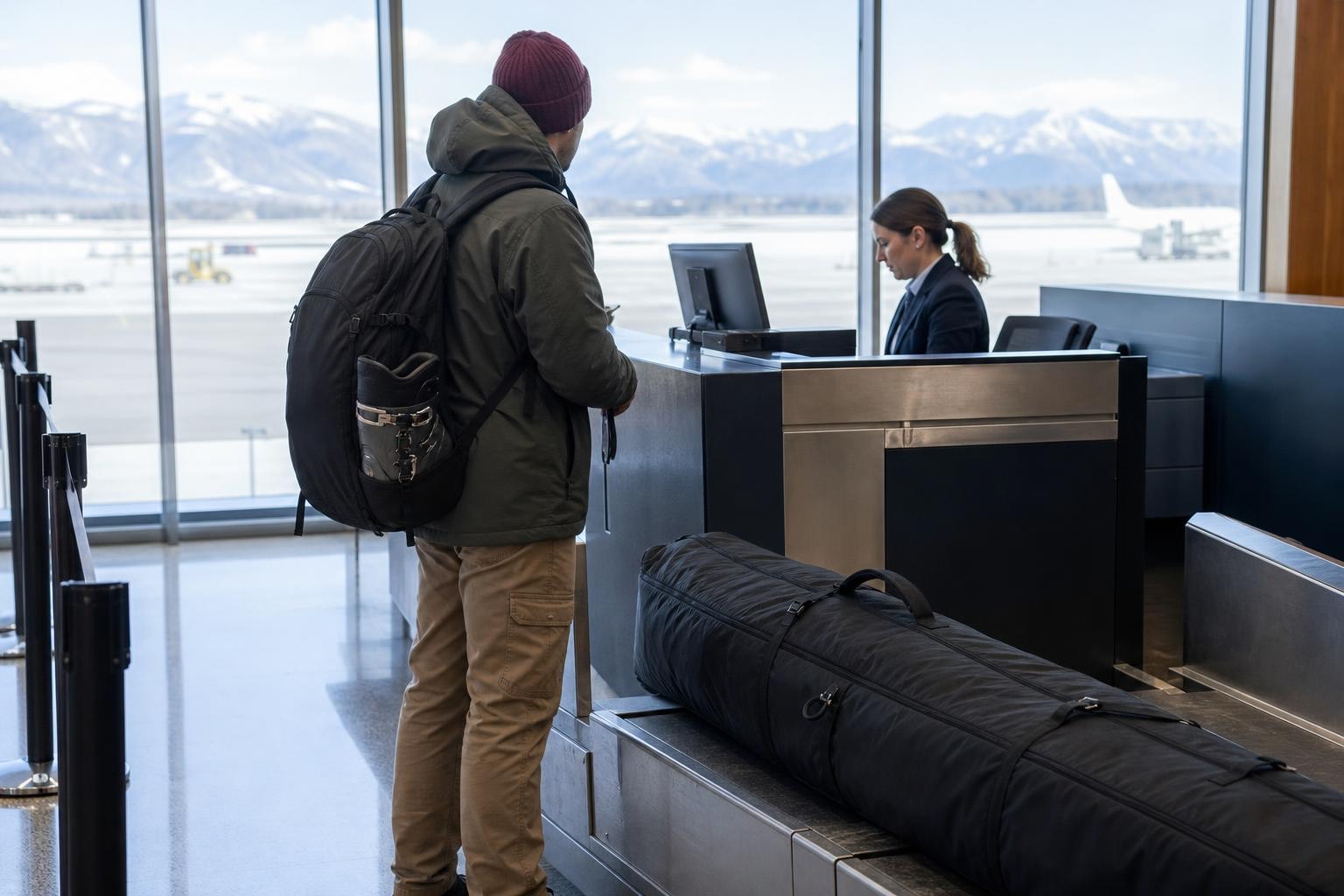
Southwest treats snow skis as checked baggage. A ski bag and a separate boot bag can count as one checked item, but only when the two bags contain the listed ski equipment. Standard bag fees apply, each bag must stay at or below 50 lb to avoid an overweight charge, and Southwest waives the oversize fee up to its 115-linear-inch maximum.
We checked every Southwest page linked below on November 11, 2026. The fee examples cover U.S. mainland travel. Your fare, status, credit card, route, booking, and any partner airline can change the price.
Southwest ski bag policy at a glance
| Rule | Southwest policy |
|---|---|
| How the gear counts | Up to two bags containing one ski or snowboard set, poles, and one pair of boots count as one checked item |
| First checked bag, U.S. mainland | $45 on Basic, Choice, and Choice Preferred; included with Choice Extra |
| Standard weight | Each bag at or below 50 lb |
| Overweight, U.S. mainland | $100 at 51 to 70 lb; $200 at 71 to 100 lb, plus the standard bag fee |
| Ski-equipment size | Oversize fee waived from 63 to 115 linear in; equipment over 115 linear in is not accepted |
| Carry-on boot bag | One carry-on up to 24 × 16 × 10 in plus one personal item that fits under the seat |
| Damage caveat | Plastic-bag and soft-sided-case conditions can limit liability; standard domestic cap is $4,700 for proven loss, subject to contract terms |
Sources: Southwest's official ski-equipment policy, optional travel charges, carry-on policy, and Contract of Carriage, checked November 11, 2026.
Do a ski bag and boot bag count as one item?
Yes, if you follow Southwest's equipment list. Its ski page says:
“We allow up to two bags (containing one set of snow skis or one snowboard, one set of ski poles, and one pair of ski/snowboard boots packed in a container(s) acceptable to Southwest) to count as one item, even if they are packed and tagged separately.”
That quote comes from Southwest's ski-equipment policy, checked November 11, 2026.
The paired-bag rule does not give you two general luggage bags. Keep the ski bag to the skis or snowboard and poles, and the boot bag to the one pair of boots named in the policy. Southwest does not say on this page that clothing or a helmet belongs in the paired boot bag. Put ordinary travel items elsewhere when you check the boots with the skis.
If you carry the boots into the cabin instead, the checked ski bag uses one checked-bag allowance by itself. Carrying your fitted boots also keeps them available if the checked skis arrive late. See how to fly with ski boots for a cabin packing plan.
Southwest ski bag fees
Southwest says, “Standard checked bag fees and overweight bag fees apply to snow and water ski equipment.” Its U.S. mainland fee table lists these first-bag prices:
- Basic: $45 each way
- Choice: $45 each way
- Choice Preferred: $45 each way
- Choice Extra: first and second checked bags included
The same official fee table says, “Sports Equipment: Standard Checked Bag Fees Apply.” These quotes and prices come from Southwest's optional travel charges, checked November 11, 2026.
A-List, A-List Preferred, eligible Rapid Rewards credit-card, Companion Pass, active-duty military, group, and interisland Hawaii benefits differ. Partner-airline flights can follow the partner's rules. Check the reservation rather than assuming the $45 mainland price applies to every trip.
Weight, size, overweight, and oversize rules
Southwest applies the 50 lb threshold to each of the two bags, not their combined weight. Its ski page says:
“Each bag must weigh 50 pounds or less to be exempt from an overweight bag fee.”
For U.S. mainland sports equipment, the fee page lists “Overweight (51-70 lbs.) $100 + Standard Fee” and “Overweight (71-100 lbs.) $200 + Standard Fee.” It also lists “Oversized (63"-115") Waived.” Southwest's ski page adds that equipment “over 100 pounds in weight and/or 115 inches in total dimensions cannot be checked as baggage.” All quotes and fees were checked November 11, 2026 on the ski-equipment page and fee page.
Weigh both bags at home. A 45 lb ski bag and a 20 lb boot bag avoid the overweight fee because each piece stays under 50 lb. A 52 lb ski bag and a 10 lb boot bag do not, even though their combined weight is lower.
Linear size means length plus width plus height. Measure the packed bag at its widest points, including wheels and handles. Southwest waives the ski-equipment oversize charge, but it does not accept the equipment above 115 linear inches.
Can a ski boot bag be a Southwest carry-on?
Yes, when the packed bag fits the cabin allowance. Southwest's carry-on page says:
“You may bring one carryon bag and one personal item onboard.”
It gives the carry-on “Size limit: 24” (length) × 16” (width) × 10” (height)” and says, “Wheels, handles, and any attachments count toward these dimensions.” A personal item goes under the seat. These quotes come from Southwest's carry-on policy, checked November 11, 2026.
Measure a boot bag after packing it, with the helmet attached. Diamant publishes its Weekend Warrior 40L and 50L inside Southwest's 24 × 16 × 10 in carry-on maximum. Southwest says a bag that is too large to carry on should be checked at the ticket counter. Compare the published bag sizes on our Weekend Warrior 40L vs 50L page or browse carry-on ski boot bags.
A cabin boot bag and a checked boot bag are different choices. If you check the boot bag beside the skis, use Southwest's paired-equipment rule. If you carry it on, it uses your carry-on or personal-item allowance.
Southwest damage liability for ski equipment
Use a protective ski bag rather than a thin plastic sack. Southwest's ski page states:
“Snow ski equipment packed in a plastic bag will be transported only with a limited release of liability.”
Southwest's fee page also says accepted sports equipment “may be subject to a limited release of liability as outlined in the Contract of Carriage.” The current Contract of Carriage lists “Soft-sided cases or unprotected/unpacked items, for which Southwest is not liable for damage and loss of contents” among its limited-release conditions. It sets the standard domestic liability cap at $4,700 per fare-paying passenger for proven loss, subject to the contract's limits. A cap is not an automatic payment, and the soft-case exclusion matters for many fabric ski bags. These official sources were checked November 11, 2026.
Photograph the gear and the closed bag before check-in. Pad the tips, tails, bindings, and pole ends, then inspect the bag at baggage claim. Our ski-bag packing guide covers the packing order.
Before you leave for the airport
- Confirm the operating airline on every flight.
- Check whether your fare or Rapid Rewards benefits include a checked bag.
- Keep the ski bag and checked boot bag within Southwest's listed equipment contents.
- Weigh each bag separately and keep each one at or below 50 lb if possible.
- Measure the ski bag and confirm it is no more than 115 linear inches.
- Measure a cabin boot bag after the boots, helmet, and pockets are packed.
- Save Southwest's current ski policy and fee page on your phone.
Southwest's published combination is useful for a skier who wants separate ski and boot bags. The important detail is the per-bag weight test: two pieces can count as one checked item, but either piece can trigger an overweight fee on its own.