You can sharpen ski edges at home when the side bevel is known and the damage is minor. Clamp the ski securely, use a file guide set to the existing angle, remove only enough steel to restore the edge, then deburr and polish with diamond stones. Do the edge work before waxing.
Do not guess the bevel or file freehand. A few controlled passes at the correct angle are useful maintenance. Repeated passes at the wrong angle remove steel without producing an even edge.
Know the side edge and base edge angles
An alpine ski has two working faces on each steel edge. The base edge sits beside the running surface. Its bevel lifts that edge slightly away from the snow. The side edge is the face beside the sidewall. Its bevel helps form the finished corner that bites into firm snow.
Angle labels can look contradictory because tools use two conventions. A side guide marked 88° describes the angle of the side face relative to the base plane. That is also called a 2° side bevel because it is 2° away from square. A 90° side angle is square, with no side bevel. Base bevel is normally stated directly, such as 0.5° or 1°.
The correct answer is the ski maker's specification or the tune already on that pair, not a universal 88° setting. Atomic lists the Bent 85 with a 1.3° base edge angle and an 87° side edge angle, for example. Those model-specific figures were checked October 24, 2026, and should not be copied onto another ski.
Tool makers publish broader guidance. Toko's official edge-tuning manual, checked October 24, 2026, recommends an 87° or 88° side angle for all-round skiers and describes base guides at 0.5°, 0.75°, and 1°. Toko assigns those base settings to different racing disciplines and notes that base-side angles vary by skier. That is guidance for choosing a setup, not proof of the angle already on your skis.
Swix's Multi Edger, also checked October 24, 2026, expresses side bevel as 0° to 5° and base bevel as 0.5° to 1°. Swix says to set the base angle before the side angle. Check the scale and instructions on your own guide before it touches steel.
If you cannot confirm the current bevel from the manufacturer, a tune record, or the shop that last serviced the skis, ask a shop to measure it. Once the shop establishes the tune, write both angles on tape inside your tuning box.
Tools for home ski edge sharpening
For a controlled side-edge tune, gather:
- a ski vise or stable tuning supports
- a brake retainer or strong ski strap
- protective gloves and eye protection
- a side-edge guide that matches the existing bevel
- a ski file that fits the guide
- coarse and fine diamond stones compatible with the guide
- an edge-grinding rubber for light rust
- a clean cloth and marker
- a brush for cleaning the file
Toko recommends protective gloves in its tuning manual. Salomon's ski-tuning guide, checked October 24, 2026, lists a mill bastard file, heavy- and light-grit diamond stones, a file guide, wire brush, and gummy stone among its edge tools.
A file and a diamond stone do different jobs. The file cuts steel and resets a dull side edge. A diamond stone removes burrs, works rough spots, and polishes the filed surface. Start with the least aggressive tool that solves the problem. If a diamond stone restores a smooth, consistent edge, do not file merely because the file is on the bench.
How to sharpen ski edges step by step
1. Dry, clean, and inspect the ski
Bring the ski to room temperature and dry it completely. Retract the brake arms with a retainer. Clamp the ski without crushing it, first in the position required by your guide.
Run a cloth carefully along the edge to catch obvious burrs without using a bare finger. Look for rust, nicks, cracks, gaps between the edge and ski, and sections pushed out of line. A fingernail drawn lightly across the edge can reveal a burr, but keep your hand moving across the edge rather than along it.
Color the side edge with a marker. The first light pass will show where the tool is cutting. If it clears only the shoulder or only the corner, stop and check the angle before removing more material.
2. Remove light rust and hard burrs
Treat rust before filing so you can see the steel. Toko's manual says to remove slight rust with an edge-grinding rubber. Work only until the surface rust clears. Rust is not a reason to grind the whole edge thinner.
Use a diamond stone in the matching guide on burrs and hardened spots. Toko specifies a diamond file for fine ridges and burrs, with a coarser diamond tool for rough blemishes and hard spots. The company says dipping its diamond files in water reduces friction and recommends cleaning them periodically with its wax remover. Follow the care directions for your own stone because other makers may specify a different lubricant.
3. Check sidewall clearance
The file must contact the steel edge rather than riding on plastic or laminate above it. Toko says sidewall material should be removed when it blocks the file, using a sidewall planer until the file touches only steel.
Sidewall planing is easy to overdo. If the file cannot reach the edge and you have not used a planer before, this is a sensible point to stop and use a ski shop.
4. File the side edge in the guide
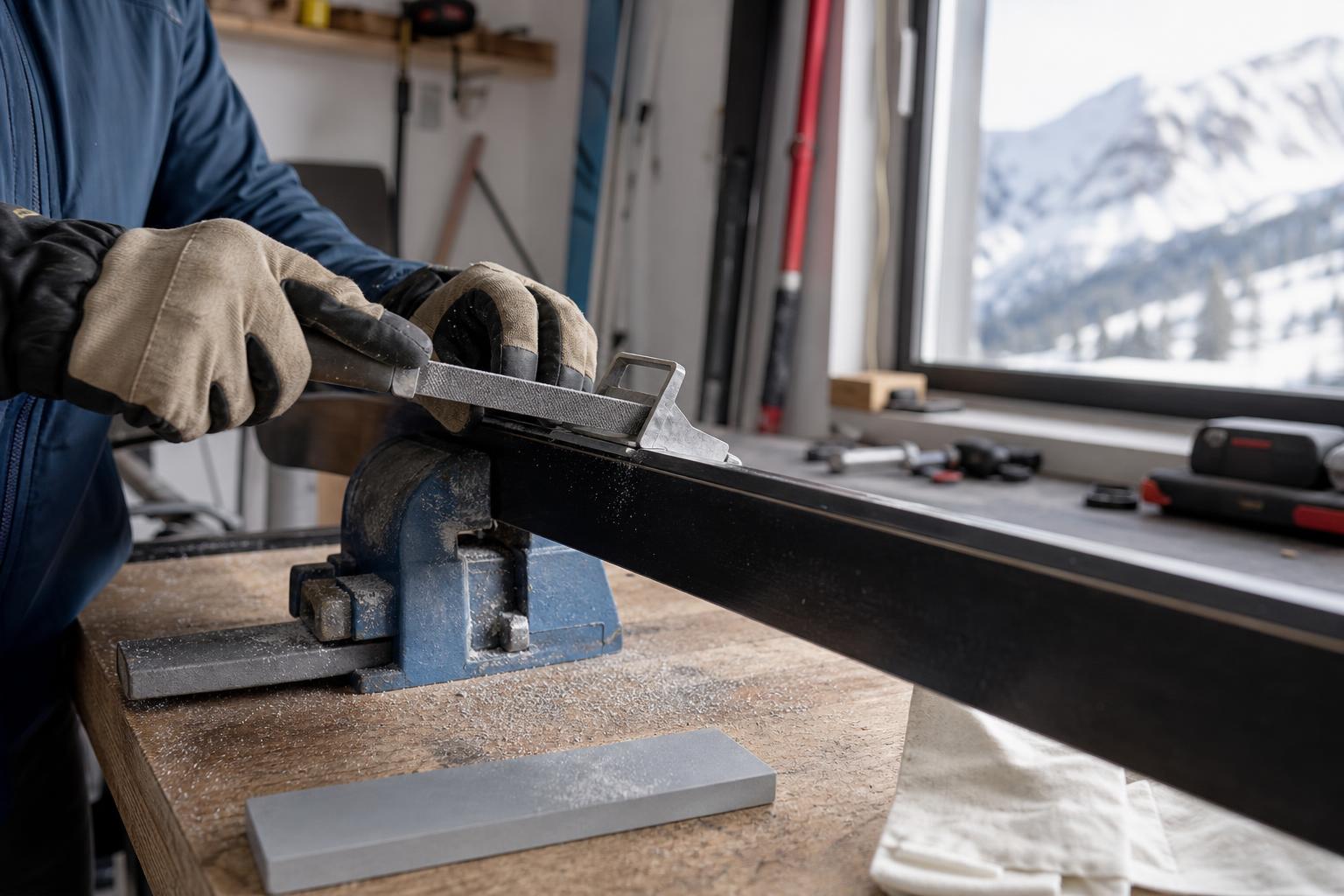
Mount the file in the guide with its cutting direction correct. Set the ski on its side, hold the guide flat against the base, and make smooth passes from tip to tail. Salomon specifies smooth, sure tip-to-tail strokes and notes that files are directional. Toko calls for gentle pressure and even strokes.
Let the file cut. Do not rock the guide, force a dull file, or add extra pressure over one nick. Check the marker after the first pass. Continue only until the ink clears evenly and the file stops catching. Use the same process and a similar number of passes on the other edges, while letting edge condition determine when to stop.
5. Polish and deburr
Replace the file with a diamond stone while keeping the same guide angle. Move from the coarser stone to the finer stone. Toko's manual calls for two or three light passes with a diamond file to remove the filing burr and polish the edge.
Check the full length again with a cloth and a light cross-edge fingernail test. The goal is a smooth, consistent corner without hanging burrs. It is not to make the edge feel dangerous in your hand.
6. Be conservative on the base edge
Routine home maintenance can include a diamond stone held in a base guide that exactly matches the existing bevel. Filing the base edge is less forgiving because every cutting pass can increase the bevel, and reducing that angle again requires work on the base.
Toko says a base that is concave or convex should be professionally ground flat. Use a shop when the base is not flat, the base angle is unknown, or you intend to change it. A side-edge touch-up is a better first home job than establishing a new base bevel.
7. Clean, then wax
Wipe away steel filings and inspect the bases before bringing out wax. Keep metal debris away from brushes used for base finishing.
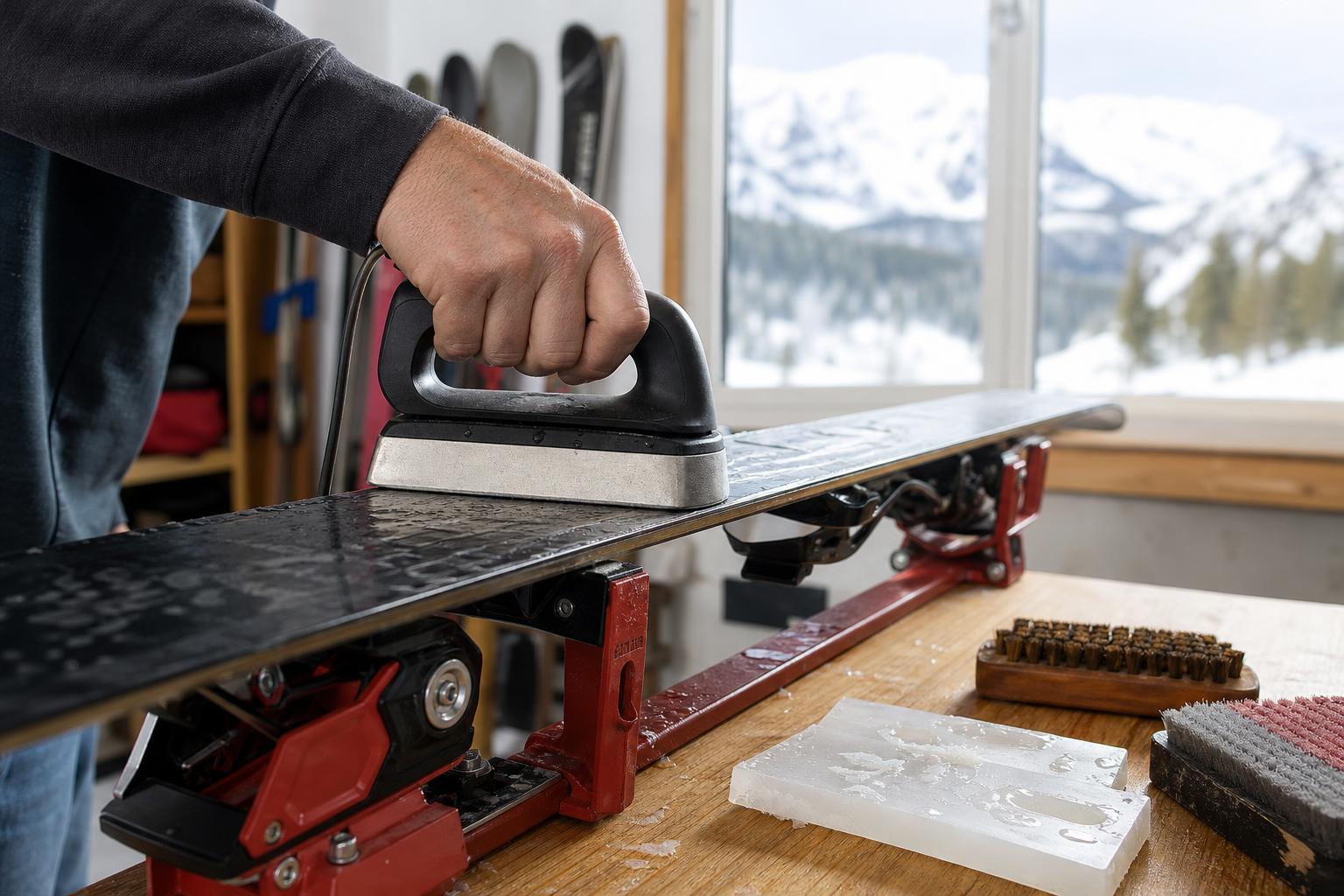
The tune-up order is base repair if needed, edges, then wax. Salomon publishes that sequence in its tuning guide. Our ski wax temperature guide covers wax selection, iron use, cooling, scraping, and brushing after the edge work is complete.
How often to sharpen ski edges
Inspect condition rather than sharpening by calendar alone. Check after a rock strike, a day on firm ice or abrasive artificial snow, and whenever the skis stop holding as expected. Remove burrs with a diamond stone before deciding that the edge needs a file.
Salomon's published guidance, checked October 24, 2026, says a careful diamond-stone touch-up every 10 days to two weeks can be sufficient where skiers do not hit rocks. Its separate recommendation for a tune after every five ski days covers the full ski-tuning routine, not a fixed filing schedule. Treat those as Salomon's maintenance references, not a promise that every edge lasts that long. Snow, impacts, technique, and the amount of steel already removed all change the interval.
Frequent light deburring preserves more material than waiting for deep damage and then filing aggressively. Record each full file tune. If you find yourself filing after nearly every outing, ask a technician whether the bevel, base flatness, or edge damage is causing the problem.
When to take skis to a shop
Use a ski shop when:
- you do not know the base or side bevel
- the base is concave, convex, or needs a stone grind
- an edge is cracked, bent, compressed, deeply pitted, or pulling away from the ski
- damage reaches the base material or ski core beside the edge
- the sidewall blocks the file and you are not comfortable planing it
- you want to change the base bevel or reproduce a race tune
- repeated guided passes do not produce even contact
Tell the technician the side and base angles you want, or ask them to identify and record the current tune. Afterward, home diamond-stone maintenance is easier because you have a known reference.
Protect fresh edges after tuning
Dry the skis before transport. Put them base to base, use ski straps, and keep the sharpened edges away from upholstery, clothing, and bare hands. Do not leave wet skis closed in a bag after the drive.
Tip covers protect only part of the ski, but they can cushion the tips and keep a pair together. TipSox's official site identifies its product as a padded ski tip cover; we checked it October 24, 2026. See the TipSox page for the directory's current fit and product details, and use our guide to carrying skis without scratching them for the walk, car, rack, and ski-bag setup.