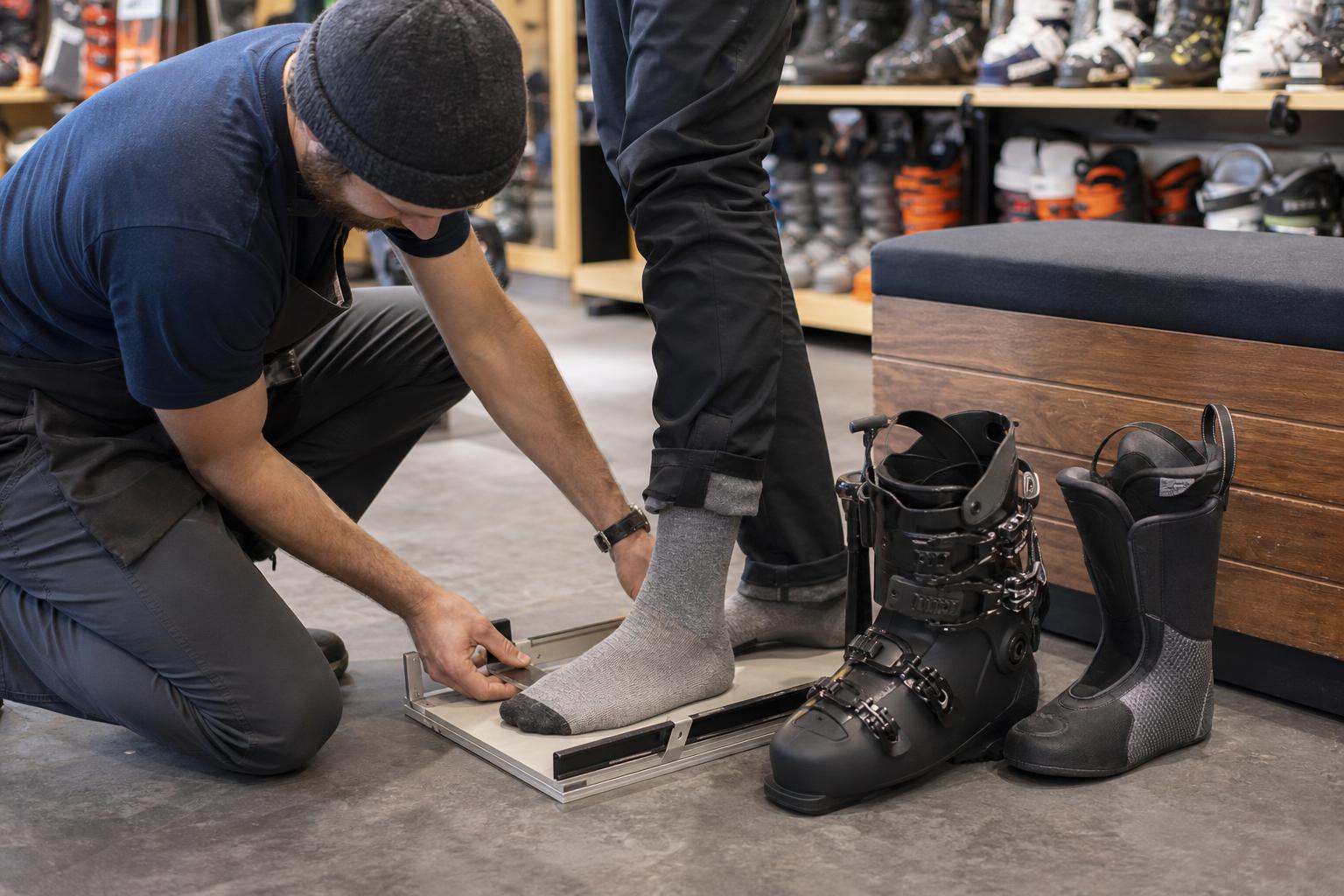
Start ski boot sizing with your foot length in centimeters, not the number inside your street shoes. That measurement is your Mondo Point starting size. A 26.5 Mondo boot corresponds to a 26.5 cm, or 265 mm, foot. Then check the shell, width, instep, heel hold, and overall volume with a bootfitter before buying.
The shoe-size conversion chart below is useful for narrowing the rack. It cannot tell you whether a particular alpine boot matches the shape of your foot.
Ski boot size chart: US shoe size to Mondo
This table uses the Standard Fit column in Nordica's official Ski Boot Sizing Chart, checked October 24, 2026. Nordica says shoe sizes vary among brands and recommends measuring the actual foot length. Its chart also has a smaller Performance Fit recommendation, which is why a conversion should not be treated as a purchase decision.
| Mondo Point | US men's shoe size | US women's shoe size |
|---|---|---|
| 21.5 | Not listed | 4.5 |
| 22.0 | Not listed | 5 |
| 22.5 | 4.5 | 5.5 |
| 23.0 | 5 | 6 |
| 23.5 | 5.5 | 6.5 |
| 24.0 | 6 | 7 |
| 24.5 | 6.5 | 7.5 |
| 25.0 | 7 | 8 |
| 25.5 | 7.5 | 8.5 |
| 26.0 | 8 | 9 |
| 26.5 | 8.5 | 9.5 |
| 27.0 | 9 | 10 |
| 27.5 | 9.5 | 10.5 |
| 28.0 | 10 | Not listed |
| 28.5 | 10.5 | Not listed |
| 29.0 | 11 | Not listed |
| 29.5 | 11.5 | Not listed |
| 30.0 | 12 | Not listed |
| 30.5 | 12.5 | Not listed |
| 31.0 | 13 | Not listed |
| 31.5 | 13.5 | Not listed |
| 32.0 | 14 | Not listed |
Read the table by shoe-size row, not as a universal foot-length equation. For example, Nordica lists US men's 8.5 at Mondo 26.5 in its Standard Fit column, while the same row's Performance Fit recommendation is 25.5. That difference is a clear reason to measure and try the shell rather than ordering from your sneaker size alone.
What Mondo Point means
Mondo Point, often shortened to Mondo, expresses ski boot size from foot length in centimeters. Atomic's Boot Hub fitting guide, checked October 24, 2026, says your foot length in centimeters is your Mondo Point. Dalbello gives the same relationship in millimeters: its official boot guide, checked the same day, says 26.5 corresponds to 265 mm.
Mondo gives you a common starting language across boot makers. It does not describe width or the vertical space over your instep. It also does not mean every half size has its own plastic shell. Atomic says a 24 and 24.5 use the same shell and liner, and its longer ski boot size guide, checked October 24, 2026, says manufacturers may adjust the shared shell with different insoles or a size adjuster.
That is why moving from 26 to 26.5 may not solve a pressure point, heel lift, or a wide forefoot. The shell family and internal shape may be unchanged.
How to measure your feet for ski boots
Atomic publishes a simple home method:
- Put paper on the floor with one edge touching a wall.
- Stand barefoot with your heel against the wall.
- Mark the end of your longest toe.
- Measure from the wall to the mark in centimeters.
- Repeat for the other foot and use the longer measurement as your Mondo starting point.
Those steps were checked on Atomic's Boot Hub on October 24, 2026. Measure while standing so the foot is fully weighted. Do both feet because they may not have the same length.
Write down more than the long number. A bootfitter will also look at forefoot width, heel width, instep height, arch support, ankle flexibility, lower-leg shape, and the amount of space around the midfoot. Atomic specifically names those factors in its fitting guide. Bring the ski socks you plan to wear rather than stacking thick socks to fill a loose boot.
How ski boots should fit
A correctly sized boot should hold the foot with little wasted movement, but tight is not a substitute for correct. HEAD's official ski boot guide, checked October 24, 2026, says your toes should brush the front when you stand upright without feeling squashed. When you bend your knees and flex forward, the toes should gain room and the heel should remain planted.
Pressure and numbness are not useful performance features. A bootfitter separates a correct snug fit from a shell that is too short, a last that is too narrow, or excess pressure over the instep. They can also check whether heel movement comes from excess shell volume, liner shape, or missing foot support.
Last width and volume
Last is the boot's reference width around the forefoot. HEAD says published last widths refer to a size 26.5 shell and generally range from 93 to 104 mm. That official guidance was checked October 24, 2026. Do not compare the same millimeter label across every shell size as though it were the width of your own foot.
Volume is three-dimensional. Atomic describes low, medium, and high volume in terms of space through the instep and toe box, not just side-to-side width. A wide boot can still press on a high instep, and a boot with enough toe width can still leave too much room around a narrow heel.
Shell fit: what a bootfitter checks
The shell fit checks the hard plastic before liner padding affects the result. Atomic publishes this process in its Boot Hub, checked October 24, 2026:
- Remove the liner from the shell.
- Put on one thin ski sock.
- Slide your foot into the empty shell until your toes just touch the front.
- Check the space between your heel and the back of the shell.
Atomic calls about 2 cm behind the heel an average fit that suits most skiers. It describes about 1 cm as a tight, high-performance fit that may need custom boot fitting for comfort, and 3 cm as too large to correct through boot fitting. Those are Atomic's published fitting references, not a reason to perform an improvised measurement and buy without trying the complete boot.
After the shell check, the bootfitter replaces the liner and checks toe contact, heel hold, pressure over the instep, cuff position, stance, and how the shell flexes under your weight. HEAD says bootfitters also consider skiing style, ability, frequency, last width, and foot profile. Depending on the boot and the foot, fit work can include a supportive footbed, liner molding, wedges, or shell modification. Those are jobs for someone who can inspect the boot, not a checklist for cutting or heating plastic at home.
Ski boot flex index basics
Flex index is a maker's number for how stiff the boot feels when you drive the cuff forward. A larger number within a line generally signals a stiffer boot. It is not a universal unit.
Atomic's ski boot size guide, checked October 24, 2026, says there is no standardized measurement method for flex index, so equal numbers are not necessarily equal across manufacturers. The company also says skier strength, anatomy, ability, and skiing style affect the choice. Use flex to compare candidates within a maker's range, then flex the actual boots with a bootfitter. Do not choose by a generic ability chart alone.
Youth ski boot sizing
Youth boots still use Mondo Point. Nordica's official junior chart, checked October 24, 2026, runs from child US 8 at Mondo 14 through youth US 10 at Mondo 28. That wide span shows why age is not a size.
Measure both feet in centimeters and use the longer foot as the starting point. Then have the child stand and flex in the complete boot while a fitter checks the shell, cuff, heel hold, and flex. Nordica says proper fit depends on foot length, foot shape, skill level, and personal preference, and directs skiers to a shop or bootfitter for the fit decision. Recheck the measurement rather than carrying last season's size forward by assumption.
Which Diamant boot bag fits your boot size?
A ski boot size also matters when you choose a travel bag. Diamant's current product pages give this guidance, checked October 24, 2026 (Weekend Warrior rechecked November 4, 2026):
| Diamant boot bag | Diamant's published boot-size guidance |
|---|---|
| Weekend Warrior 40L | Fits up to size 28.5 |
| Weekend Warrior 50L | Fits up to size 32 |
| The XL | Fits up to size 32 |
The Weekend Warrior product page says boot shapes vary and asks customers to contact Diamant for help choosing. The XL product page lists its own up-to-size-32 limit. We have not independently fit boots in these bags, so treat those numbers as Diamant's published guidance rather than a guarantee for every shell shape.
See the Weekend Warrior 40L vs 50L comparison for which size fits your boots, the directory's Diamant Gear page for the other bag formats, or compare the broader ski boot bag directory. Once the trip is over, unpack the boots rather than leaving damp liners zipped inside. The overnight ski boot drying guide covers the safe routine.
A size chart gets you to the right shelf. Foot measurements, a shell fit, and a complete fit check decide which boot should leave the shop with you.