Mips is a low-friction system inside some helmets. During certain angled impacts, it lets the helmet move 10 to 15 mm relative to the head. Mips says that movement is intended to help reduce rotational force transferred to the head. It does not make a helmet concussion-proof, and it does not replace a snow-sports safety certification or a correct fit.
For a ski helmet, start with a model labeled for snow sports under ASTM F2040 in the United States or CEN EN 1077 in Europe. Measure your head, try the helmet with your goggles, and follow that helmet maker's replacement instructions. Mips is one feature to compare after those basics.
What Mips means in a helmet
Mips was originally an acronym for Multi-directional Impact Protection System. The company now uses Mips as its name and describes the technology as a low-friction layer inside the helmet, usually between the comfort padding and the EPS foam protective layer.
A straight impact and an angled impact do not load a helmet in the same direction. In an angled impact, the helmet can experience rotational motion as well as a direct force. The Mips layer is designed to let the helmet and head move slightly relative to each other during that brief event.
Mips' official snow-helmet page, checked October 24, 2026, specifies 10 to 15 mm of multi-directional movement in certain angled impacts. The company says the system is intended to help reduce rotational forces transferred to the head. Its disclaimer also says no helmet, including one with Mips, can guarantee that a wearer will avoid concussion, brain injury, or other injury.
Can Mips guarantee that you will avoid a concussion? No. Mips says no helmet can guarantee that outcome or prevent all injuries. The 10 to 15 mm movement happens during certain impacts; the helmet should not slide around during a fit check.
Do not remove, reposition, or cut the low-friction layer. If it looks displaced or damaged, stop using the helmet and follow the helmet maker's instructions.
How does Mips work?
A common Mips snow-helmet design has three parts around your head:
- Comfort padding touches your hair and scalp.
- A low-friction layer allows a small amount of multi-directional movement.
- EPS foam and the outer shell manage impact energy according to the helmet's design.
The exact construction varies by helmet. You may see a yellow Mips layer, small yellow anchors, or a Mips label, but color alone is not a dependable buying test. Check the sewn label, packaging, and the maker's specification for the exact model. Mips says it tests a helmet model after the system is integrated.
Mips is a helmet feature, not an activity-specific certification. For skiing, check the snow-sports standard on the helmet label.
Mips vs non-Mips ski helmets
Mips helmets and non-Mips helmets can both carry a snow-sports certification. A helmet with Mips still needs the right size and condition. Use this order when comparing them:
| Check | Mips helmet | Non-Mips helmet |
|---|---|---|
| Snow-sports certification | Still required | Still required |
| Rotational-motion feature | Uses a Mips system | May have no added system or may use another design |
| Fit | Must sit level and stay secure | Must sit level and stay secure |
| Injury guarantee | None | None |
| Replacement after impact | Follow the helmet maker; replace when directed | Follow the helmet maker; replace when directed |
Is it bad to get a helmet without Mips? No. A non-Mips helmet can still meet ASTM F2040 or EN 1077. Mips is not a certification, and the label cannot rescue a helmet that slides around, causes pressure, has crash damage, or was made for another activity.
If two certified snow helmets fit equally well, Mips gives you a specific rotational-management feature to compare. Other makers may use different constructions. Read the exact product specification rather than treating every colored liner or proprietary name as the same technology.
Ski helmet safety standards: ASTM F2040, EN 1077, and the CPSC note
Look inside the helmet or on its permanent label for the standard. A store category or product title is not enough.
ASTM F2040 is ASTM International's active specification for helmets used in nonmotorized recreational snow sports. ASTM's official F2040 scope, checked October 24, 2026, explicitly includes skiing, snowboarding, and other alpine sports. The standard includes performance requirements and testing, but ASTM warns that protection remains limited.
CEN EN 1077 covers helmets for alpine skiers and snowboarders. CEN-CENELEC's standards overview, checked October 24, 2026, identifies EN 1077:2007 as the European standard that sets requirements for helmets used by both groups.
The CPSC bicycle-helmet standard is not the snow-sports label to look for. The U.S. Consumer Product Safety Commission activity chart, checked October 24, 2026, directs skiing, snowboarding, and snow tubing to a snow-sports helmet meeting ASTM F2040 or Snell S-98/RS-98. A bicycle helmet may carry a CPSC bicycle label, but that does not turn it into a ski helmet.
Certification does not mean a helmet prevents every head injury. Ski in control, follow the mountain's responsibility code, and replace a helmet when its maker directs.
Ski helmet size chart
Helmet letters are not universal. These current adult charts show why you need the chart for the exact model.
| Adult size | Smith Level | Giro snow helmets |
|---|---|---|
| S | 51–55 cm | 52–55.5 cm |
| M | 55–59 cm | 55.5–59 cm |
| L | 59–63 cm | 59–62.5 cm |
| XL | 63–67 cm | 62.5–65 cm |
The Smith Level product chart and Giro size chart supplied these ranges; both were checked October 24, 2026. Smith also publishes separate Round Contour Fit ranges, while Giro separates race and youth ranges from its adult snow chart. Do not transfer a medium from one maker, model, or fit shape to another without checking its centimeter range.
How to measure for a ski helmet
- Wrap a soft measuring tape around the widest part of your head, about one inch above your eyebrows.
- Keep the tape level around the back of your head. It should touch without digging in.
- Record the circumference in centimeters and measure a second time.
- Compare the number with the exact model's chart.
- If you fall on a boundary, try both neighboring sizes.
No flexible tape? Wrap a non-stretch string around your head, mark the overlap, then lay it against a ruler. Do not add room for a thick hat. A helmet should fit your bare head or the thin liner configuration its maker permits.
Check the fit with your goggles
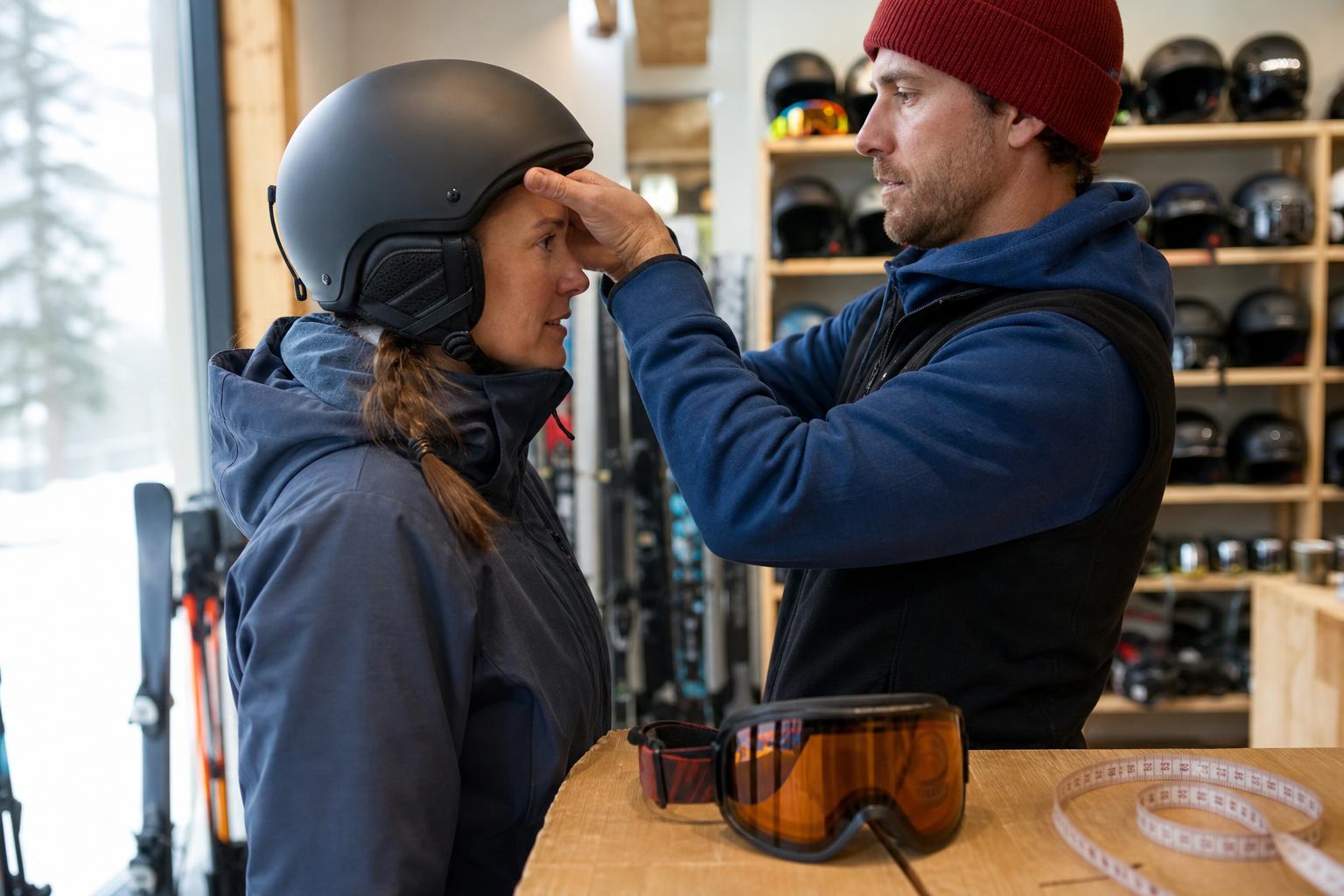
Put the helmet on level, with the front low enough to cover your forehead without blocking vision. Adjust the rear fit system until the helmet feels snug around the whole head. Fasten the chin strap according to the maker's instructions. The ski goggles guide covers the goggle side of that fit.
Then check four things:
- The helmet stays in place when you shake your head gently.
- It does not create a sharp pressure point at the forehead, temples, or back of the head.
- The goggle frame meets the helmet without a large exposed gap.
- The helmet does not push the goggles down onto your nose.
Our what to wear skiing guide uses the same fit advice and covers the rest of the head, eye, hand, and layer setup. A folded beanie under the helmet can change its fit.
When to replace a ski helmet
Use the replacement interval published by your helmet's maker. There is no single date that applies to every construction and brand.
Smith's ski and snowboard helmet replacement guide, checked October 24, 2026, says to replace a helmet after a crash or impact even when it looks undamaged. Without a known impact, Smith recommends replacement every five years of active use or ten years from the manufacture date, whichever comes first. That is Smith's schedule, not a universal expiration rule for every helmet.
Check the manufacture-date sticker, often under the removable liner, and read your own manual. Replace the helmet sooner when you find:
- a cracked, dented, or deeply scratched shell
- compressed, cracked, crumbling, or separated foam
- a torn strap, unreliable buckle, or broken fit system
- a displaced or damaged Mips layer
- a fit that no longer stays secure
- an impact after which the maker directs replacement
Do not buy a used helmet when you cannot verify its impact history, age, and storage. A clean shell cannot show every change inside the foam.
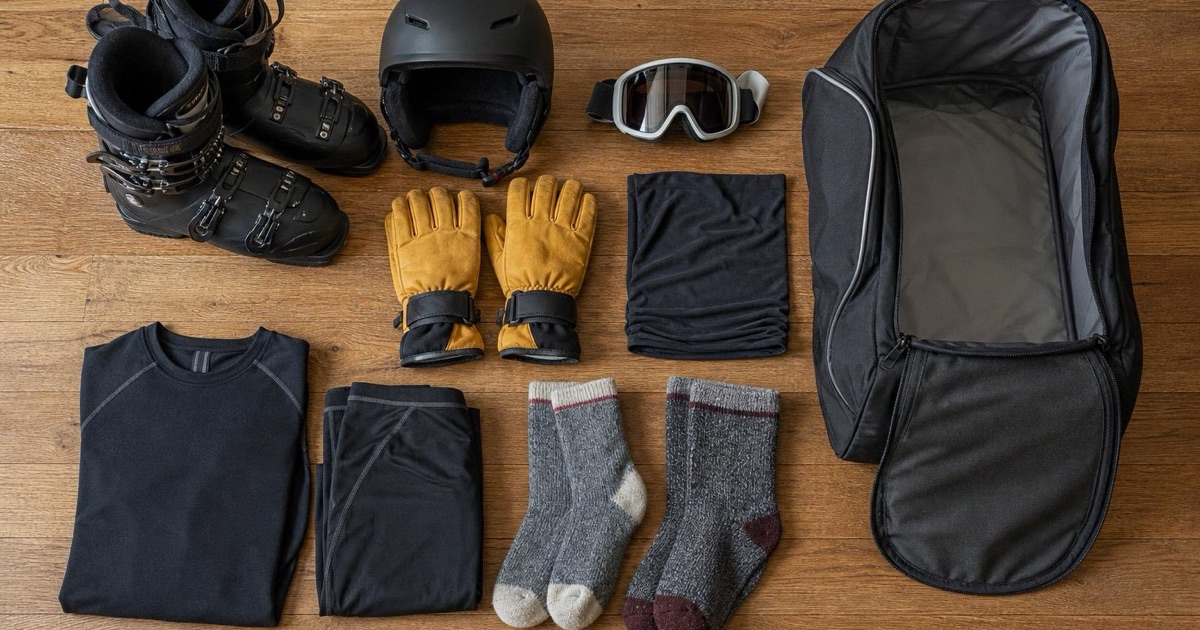
Store the helmet dry and away from high heat. After a ski day, open the bag and let the liner dry before repacking. Diamant lists helmet canopies on bags in our ski boot bag directory. A canopy keeps the helmet outside the boot compartment during travel, but it does not make the helmet crush-proof. Do not put a heavy bag on top of it.
Ski helmet vs snowboard helmet
For ordinary resort use, you do not need separate ski and snowboard helmets. ASTM F2040 covers both skiing and snowboarding, and CEN EN 1077 addresses alpine skiers and snowboarders. Makers often sell the same product as a snow, ski, or snowboard helmet.
Choose by certification, fit, goggle compatibility, ventilation, ear coverage, and the maker's intended use. Style labels do not change the standard. A snowmobile helmet, climbing helmet, bike helmet, or skate helmet serves a different activity unless its permanent labels also show the snow-sports certification you need.
If you switch between skis and a snowboard on the same trip, one correctly fitted certified snow helmet can serve both. Add it to the ski trip packing list once, then check the shell and straps before each day.
Do you need a helmet to ski?
Wear a certified snow-sports helmet when you ski. A helmet reduces only part of the risk, so keep your speed and line under control as if you were not wearing one.
The rule at the mountain can depend on the resort, age, lesson, race, or program. Vail Ski & Snowboard School, checked October 24, 2026, requires a winter-sports helmet for every lesson participant under 18 and encourages helmets for everyone else. The National Ski Areas Association, checked the same day, urges skiers and riders to wear helmets while skiing or riding responsibly.
Check your resort and lesson policy before you leave home. If you plan to rent, confirm whether a helmet is included or needs a separate reservation. When you use the day-trip ski checklist, put the helmet beside your goggles and gloves so it does not stay on the garage shelf.