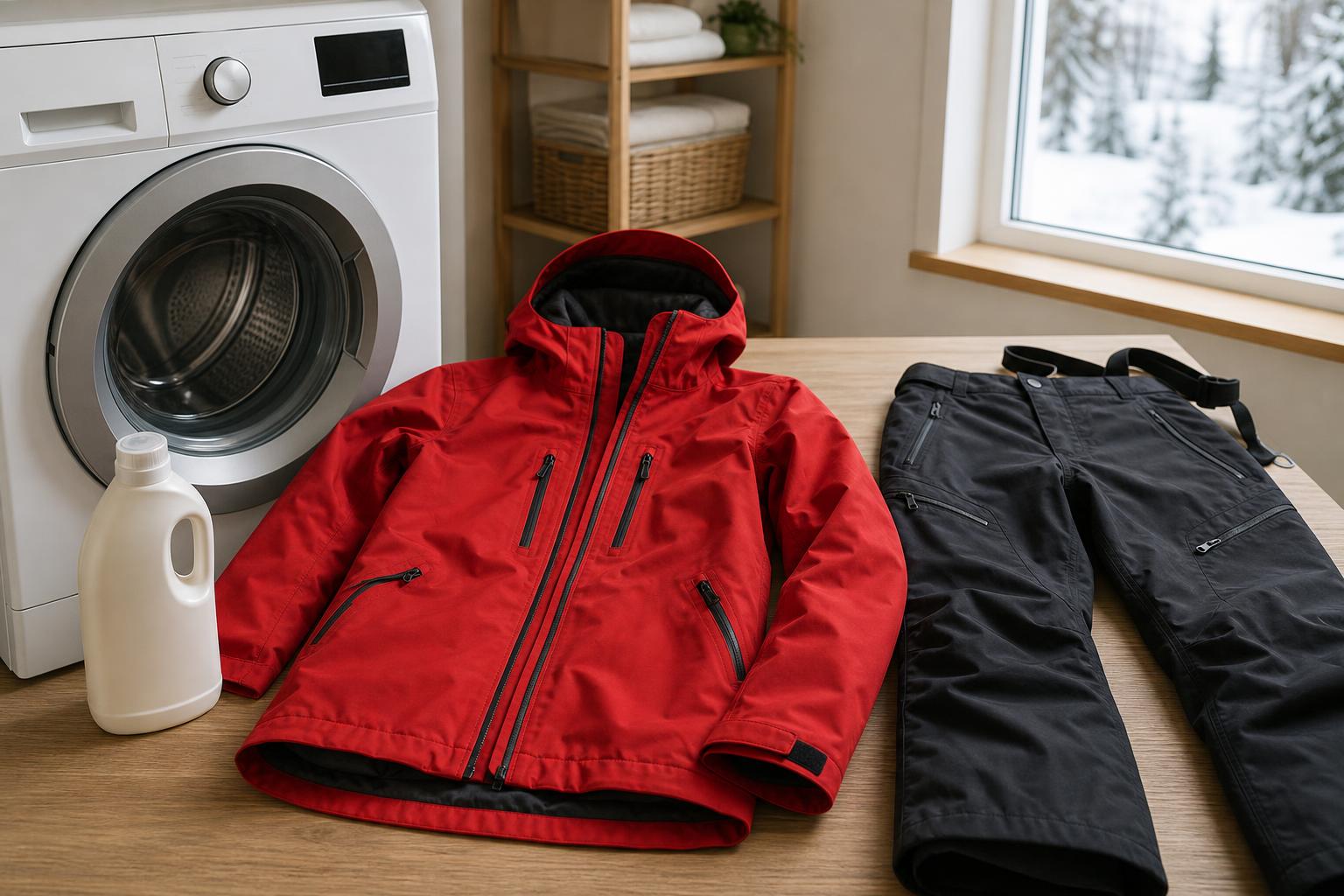
You can wash most ski jackets and ski pants in a washing machine, but the sewn-in care label decides the detergent, cycle, temperature, and drying method. Empty the pockets, prepare the zippers and hook-and-loop tabs, wash with the product the maker specifies, rinse thoroughly, then dry exactly as labeled. Fabric softener, bleach, uncontrolled heat, and a guess based on another jacket are the common mistakes to avoid.
The numbers in this guide are maker-specific examples, not one setting for every piece of ski clothing. GORE-TEX, Salomon, and Arc'teryx publish different instructions for different constructions. Read your jacket and pants labels before turning a dial.
Before you wash a ski jacket or pants
Start with the care label. If the label says hand wash, do not substitute a machine's delicate cycle. If it prohibits tumble drying or ironing, skip the heat-reactivation steps below and contact the garment maker for that product's DWR instructions.
Then prepare the garment:
- Empty every chest, sleeve, hand, and interior pocket. Check for lift tickets, lip balm, tissues, and hand warmers.
- Brush away loose mud and wipe off surface dirt.
- Close the main zipper, pit or leg vents, and other exposed zippers unless your garment maker says otherwise.
- Secure hook-and-loop cuff tabs so they cannot catch the face fabric.
- Release tension from drawcords if the maker directs it.
- Remove detachable faux-fur trim or other parts only when their labels call for separate care.
- Check the detergent drawer and drum for softener or ordinary-detergent residue. Run the rinse cycle first if the garment maker tells you to.
Pocket-zip advice is not universal. GORE-TEX's outerwear care instructions, checked October 24, 2026, say to close front, pocket, and pit zips completely. Arc'teryx's GORE-TEX and technical outerwear guide, checked the same day, says to close main and pit zippers but open pocket zippers on its garments. That is a good reason to follow the label and brand instructions for the item in your hands.
Wash compatible jacket and pants together only if their labels specify the same detergent, cycle, temperature, and drying method. Otherwise, split the load. Wash base layers separately according to their own labels.
How to wash a ski jacket and ski pants
Use this sequence, replacing every setting with the one on the garment label when they differ:
- Choose the right cleaner. GORE-TEX calls for a small amount of liquid detergent. Arc'teryx specifies a technical detergent for its technical outerwear and a down-specific detergent for down. Do not use dish soap as a substitute.
- Use the labeled water temperature and cycle. Do not assume every waterproof jacket wants cold water or every synthetic cycle is safe.
- Keep the load light. GORE-TEX says its outerwear may be washed with similar garments that are not heavily soiled.
- Rinse thoroughly. GORE-TEX and Arc'teryx both call for a second rinse in their linked technical-shell instructions.
- Minimize hard spinning. Use the care label's limit rather than the fastest spin your washer offers.
- Inspect before drying. Confirm that detergent has rinsed out and no closure has snagged.
Here is why one universal settings chart would be misleading:
| Official source, checked October 24, 2026 | Published wash direction |
|---|---|
| GORE-TEX outerwear care | Machine-wash at 105°F (40°C), use a small amount of liquid detergent, rinse twice, and minimize spinning. If there is no permanent-press setting, GORE-TEX says a gentle cycle at 400 rpm or lower minimizes creasing. |
| Salomon ski and snowboard jacket and pants care | For the synthetic ski clothing covered by its guide, Salomon says 86°F (30°C) on a synthetic cycle with no more than 800 rpm. The guide sends owners of clothing with a GORE-TEX-type membrane to separate membrane instructions. |
| Arc'teryx GORE-TEX and technical outerwear care | For its technical outerwear, Arc'teryx says 104°F (40°C) on a regular cycle with technical detergent, followed by a double rinse. |
All three direct you back to garment-specific care. Use the row that belongs to your garment's maker and fabric, not whichever number looks gentlest.
Detergent and stain treatment
Read both the garment label and detergent directions. A technical wash is designed to rinse without the softeners and brighteners Arc'teryx warns can remain on technical outerwear. GORE-TEX permits a small amount of liquid detergent and advises against powder detergent, fabric softener, stain remover, and bleach.
For a stain on GORE-TEX outerwear, the brand says to apply liquid detergent locally or use the washer's prewash cycle. If the machine lacks prewash, its guidance allows soaking the garment in warm water with liquid detergent. It does not recommend stain remover. Those directions were checked October 24, 2026. For another fabric, use its maker's stain instructions rather than carrying that method across.
Do not pour Dawn or another dish soap into the washer for a down jacket. Arc'teryx's down wash guide, checked October 24, 2026, specifies down detergent for its down products because ordinary cleaners can affect the natural oils and loft of the fill.
How to dry and reactivate DWR
Drying does two separate jobs. It removes water from the garment, and approved heat can reactivate the durable water repellent treatment, or DWR, on the outer fabric. DWR is the treatment that makes water bead and roll off instead of soaking into the face fabric. It is not the waterproof membrane itself.
Follow the garment label first. For standard GORE-TEX outerwear, the brand says to tumble dry on a warm, gentle cycle or line dry. Once the item is dry, it calls for another 20 minutes in the dryer to reactivate DWR. If a dryer is unavailable and the care label permits ironing, GORE-TEX says to use a gentle warm setting with no steam and place a towel or cloth between the iron and garment.
Do not apply that heat routine blindly. GORE-TEX says not to tumble dry, iron, or apply DWR to garments with a persistent beading surface such as GORE-TEX SHAKEDRY. The label identifies the care route.
Arc'teryx gives its own shell timing. Its linked technical-outerwear guide says low or medium dryer heat for 40 to 50 minutes, or line drying, followed by 20 minutes on gentle heat once fully dry. Those times apply to the Arc'teryx garments covered by that guide, checked October 24, 2026.
How to reproof a ski jacket and pants
Clean and dry the garment before deciding that it needs new DWR. Dirt and detergent residue can reduce beading, and approved drying heat may restore the existing finish. Test the clean garment with a light spray of water. If droplets no longer bead and run off, check the maker's instructions for reproofing.
GORE-TEX says a pump spray or wash-in DWR can be used on compatible garments, followed by 20 minutes of tumble drying to activate the treatment. If the label allows ironing instead, the brand gives the same gentle, warm, no-steam method with a cloth between the iron and fabric. Follow the DWR product's application directions too.
A spray-on treatment lets you target the face fabric. A wash-in treatment is simpler to distribute through a machine. The garment maker decides whether either method is suitable. Do not reproof SHAKEDRY or any product whose label says not to apply DWR.
Down vs. synthetic insulated ski clothes
A shell, a synthetic-insulated jacket, and a down ski jacket do not share one drying routine.
Down needs complete, controlled drying. Arc'teryx tells owners of its down garments to use down-specific detergent, wash at 104°F (40°C) on permanent press or gentle, and double-rinse. It then calls for low-heat tumble drying with two dryer balls or clean tennis balls, turning the garment inside out periodically. The company says drying can take more than three hours and that down must be completely dry before storage to avoid clumping or mold. These are Arc'teryx instructions checked October 24, 2026, not universal settings for every down jacket.
Synthetic insulation follows its own label. Arc'teryx's synthetic insulation guide, checked October 24, 2026, says to wash at the temperature on the care label, run a second rinse, and refer to the label for drying. For its garments that permit it, low tumble heat helps restore loft, but the company warns against overheating synthetic fabrics and materials.
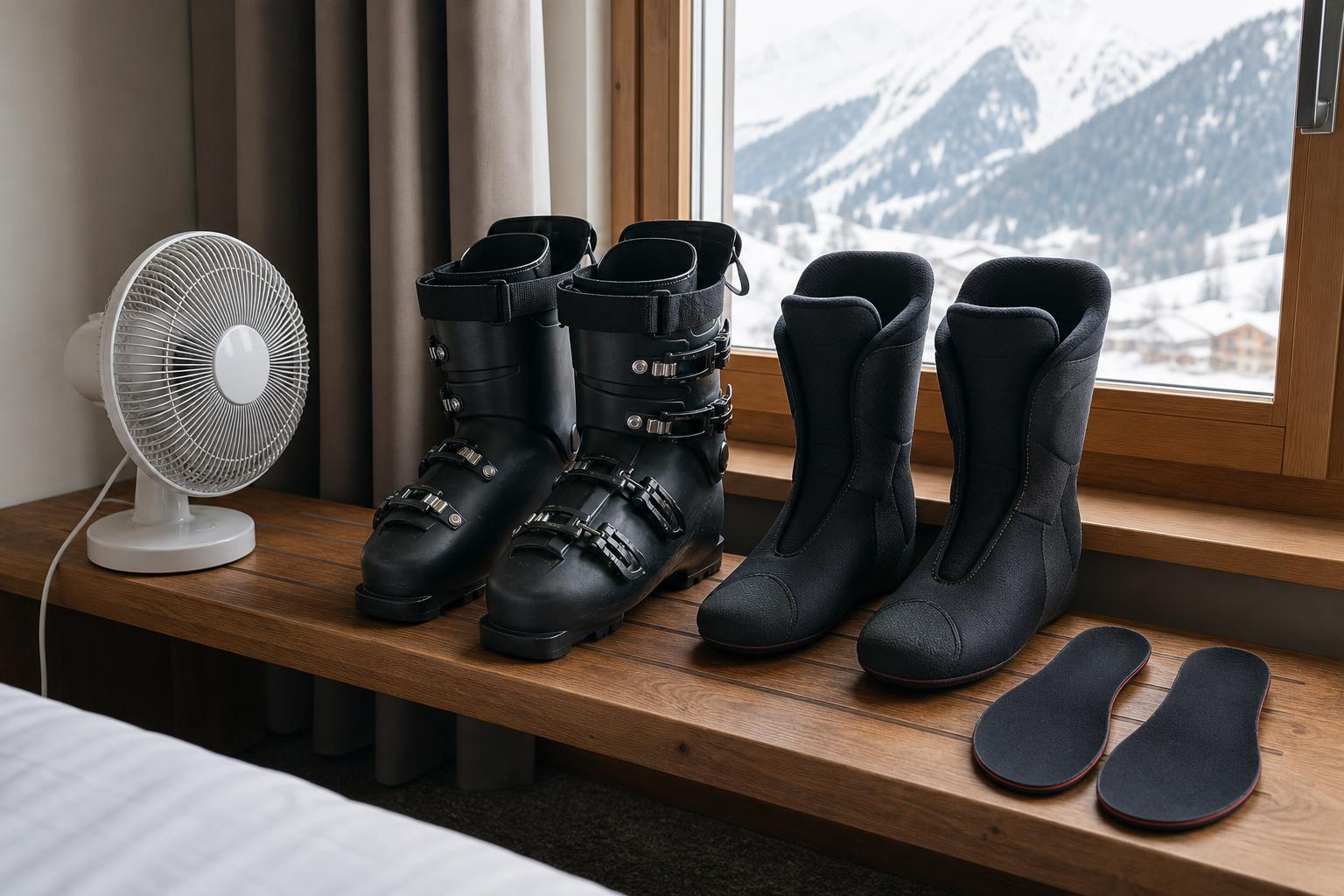
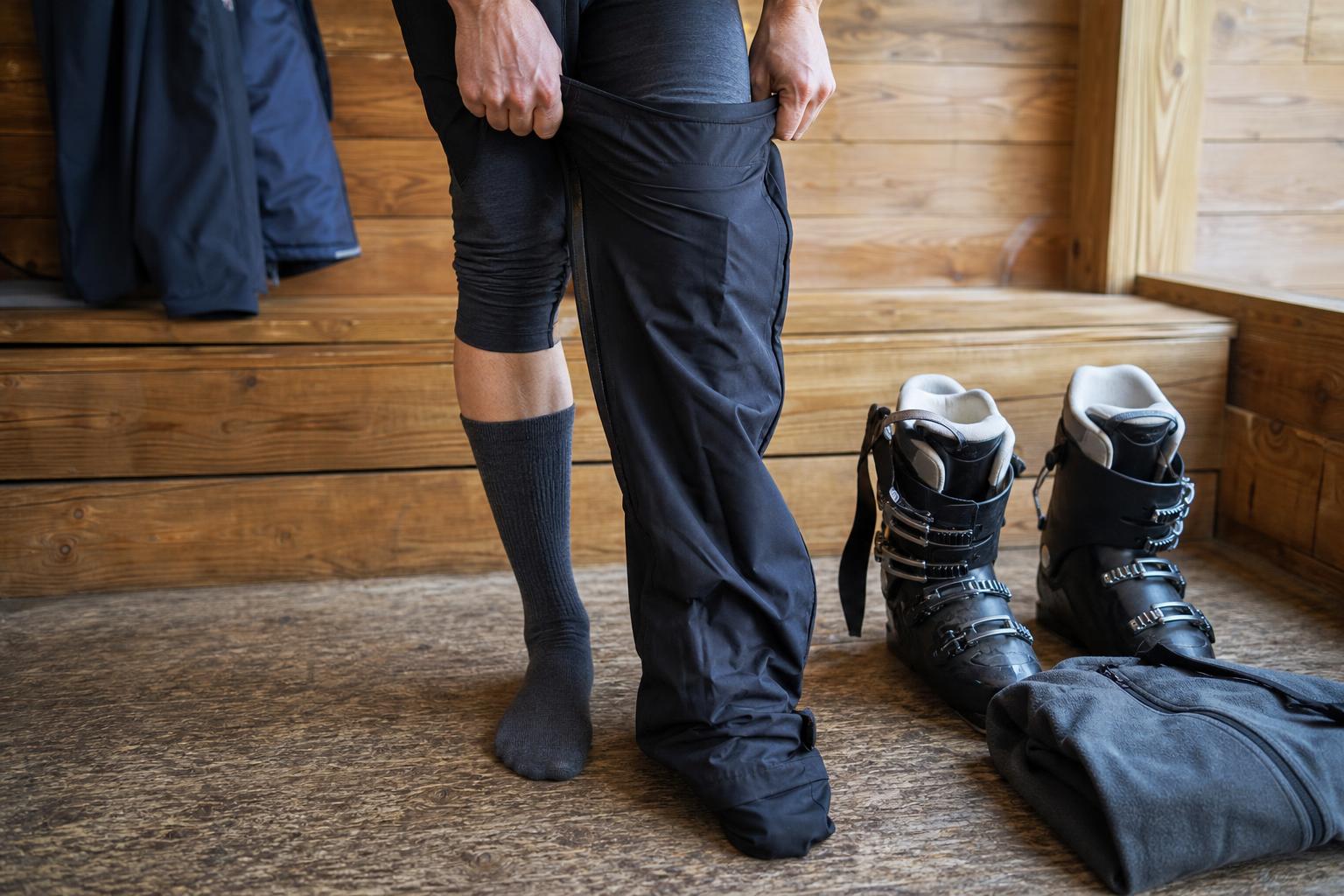
Ski pants may be uninsulated, synthetic-insulated, or less commonly down-filled. Check the pants label independently from the jacket. If you carry the clean set in a ski boot bag, make sure the jacket, pants, liners, and bag are fully dry before packing. A travel bag keeps gear together; it is not a drying cabinet.
How to wash ski gloves
Check the glove label before choosing a cleaner. Ski gloves combine shell fabric, leather, a waterproof insert, insulation, and sometimes a removable liner. One wash method can suit the textile shell and damage the leather palm or fixed lining.
Use this label-first routine:
- Shake out loose dirt and close any hook-and-loop wrist tabs.
- Remove the liner only when the glove maker designed it to come out. Wash that liner by its own label.
- Clean the shell with the method and product named by the glove maker.
- Press or squeeze out water without wringing or twisting.
- Air-dry the gloves with the openings clear and away from a heater, hair dryer, or other concentrated heat.
- Reapply leather conditioner or water repellent only when the glove maker permits it and the gloves need it.
GORE-TEX glove care, checked October 24, 2026, tells owners to hand-wash its gloves in lukewarm water with a small amount of liquid detergent. It says not to machine-wash or dry-clean them and not to use fabric softener or bleach. The brand directs users to squeeze water from the fingers toward the wrist, line-dry with the wrists pointing down, and put the half-dry gloves on to restore their shape. Follow the glove maker's inner label as well.
Leather vs. synthetic ski gloves
Leather gloves need leather-specific care. Hestra's leather sports-glove instructions, checked October 24, 2026, say to spot-clean stains with a damp cloth and high-fat soap, never put the leather gloves in a washing machine, and condition compatible leather after it dries. Hestra says not to turn a glove with a fixed lining inside out because the lining, insulation, and membrane can be difficult to put back in place. Its removable wool liners should be hand-washed and dried flat.
Synthetic gloves still need a label check. Do not assume a fabric back or nylon shell makes the whole glove machine-washable. A synthetic glove may still contain leather, insulation, adhesives, or a membrane. Follow its product instructions for hand or machine washing, then air-dry unless the label permits another method.
For smooth leather, Nikwax's leather glove guide, checked October 24, 2026, tells users to put the gloves on, wet them with lukewarm water, clean with its Footwear Cleaning Gel, rinse, and gently squeeze without twisting. Its separate fabric-and-leather glove guide, checked the same day, specifies that cleaner for its method and Glove Proof on the still-wet glove before air drying. These are Nikwax product directions, not permission to override a glove label.
How to clean ski goggles
Keep ski goggles out of the laundry load. Clean the lens and frame by hand, protect the inner anti-fog coating, and let the whole goggle dry before it goes back into a case.
- Shake off loose snow. Let stuck snow melt rather than scraping it across the lens.
- Use a clean microfiber cloth or the maker's microfiber goggle bag on the outside lens. Blot instead of grinding dirt into the surface.
- Dab the inner lens only when needed. Do not wipe or rub it while wet.
- Skip household and chemical cleaners unless the goggle maker names one for that lens.
- Air-dry the frame, foam, and lens completely in a ventilated place. Store the dry goggles in their protective bag or case.
Giro's snow-goggle cleaning guide, checked October 24, 2026, says paper products, gloves, shirts, and jackets can scratch a lens. Giro recommends a soft microfiber cloth for the outside and warns that wiping the inside can remove its anti-fog coating. Oakley's goggle care instructions, checked the same day, likewise say not to rub a wet inner lens. Oakley says to shake out snow, blot remaining moisture with the supplied Microclear bag, air-dry the goggles, and keep them away from concentrated heat and sunlight.
How often to wash ski clothes
Wash when the garment is dirty, develops odor, or stops beading water, not after an arbitrary number of ski days. Arc'teryx gives those signs for its technical outerwear. Its down guide adds loss of loft or clumping as reasons to wash down and advises against unnecessary washing.
Do not leave sunscreen, sweat, road grime, or food on the fabric for an entire season just to avoid the washing machine. GORE-TEX says contaminants and ordinary wear reduce water repellency, while washing, drying, and reheating help restore DWR on compatible garments.
At the end of the season, clean the outerwear when its condition calls for it, dry every layer completely, and store it uncompressed in a dry place. Recheck the labels next season before repeating the routine, especially if the jacket and pants use different materials.
When you pack the clean, dry clothing for your next trip, use what to wear skiing to account for the full layering system and what to wear under ski pants to keep clean base layers separate from outerwear.
What not to do
- Do not use fabric softener or bleach on technical ski outerwear when the maker prohibits them.
- Do not assume powder detergent, stain remover, or dish soap is an equivalent cleaner.
- Do not copy a temperature or spin speed from a different jacket.
- Do not leave passes, tissues, or hand warmers in pockets.
- Do not expose synthetic insulation or laminated fabric to hotter drying than its label permits.
- Do not stop drying down while clumps remain damp.
- Do not iron, tumble dry, or reproof a garment whose label prohibits it.
- Do not dry-clean ski outerwear unless the care label allows it.
- Do not put leather ski gloves in a washing machine unless their maker explicitly permits it.
- Do not wipe a wet goggle's inner lens or use a jacket sleeve, paper tissue, or household cleaner on it.
GORE-TEX says professional dry cleaning does not harm its standard fabric, but the garment maker's instructions still decide whether it is allowed. When approved, GORE-TEX asks for a clear, distilled hydrocarbon-solvent rinse and DWR treatment with heat reactivation. It says not to dry-clean SHAKEDRY and does not recommend home dry-cleaning kits. We checked that guidance on October 24, 2026.
The shortest safe routine is still the right one: label, pockets, closures, correct cleaner, labeled wash, complete rinse, labeled dry, then a water-beading check. Reproof only after cleaning and heat reactivation fail, and only with a treatment the garment instructions allow.