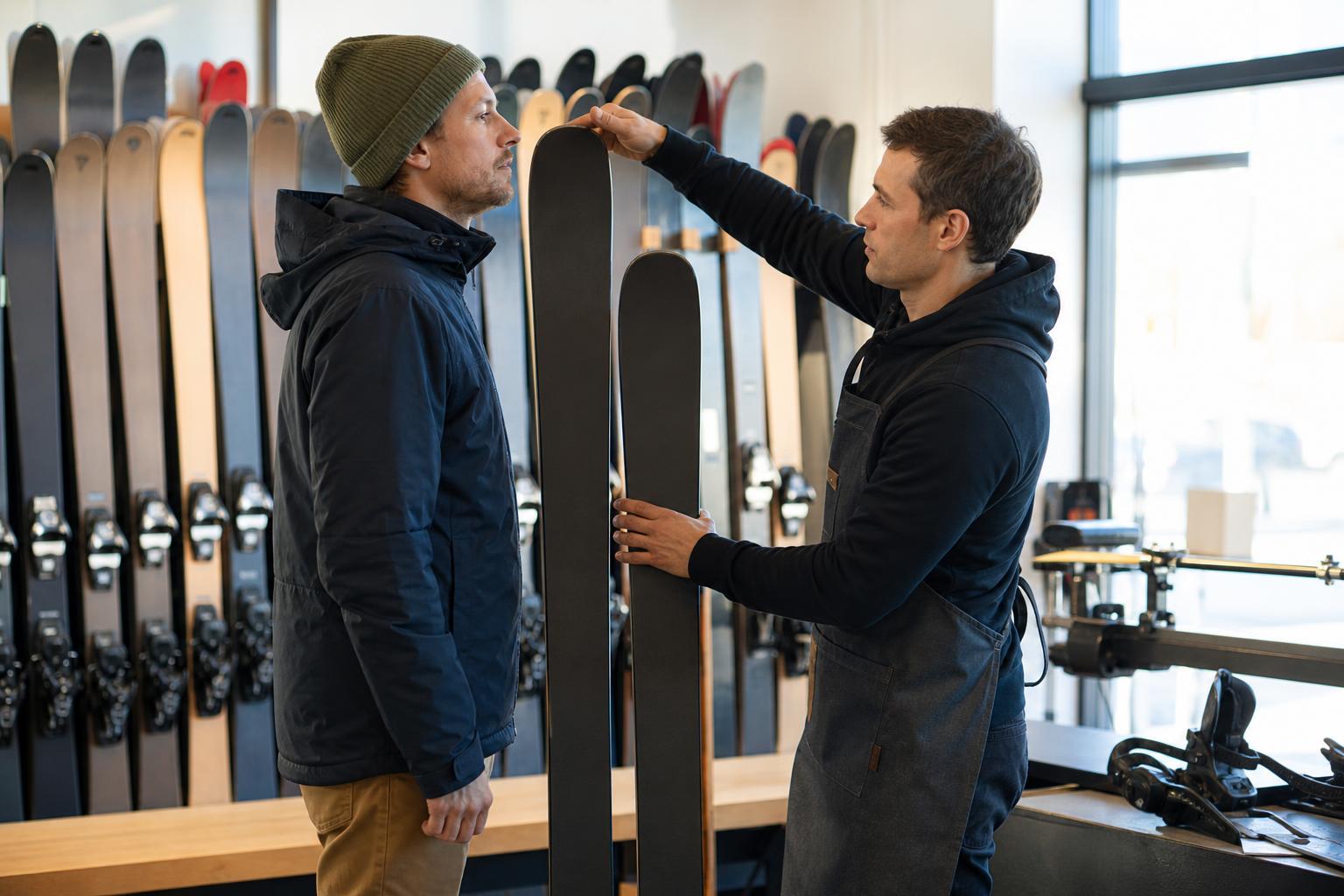
Start with your height and ability, then adjust for weight, terrain, skiing style, and the construction of the ski. There is no single ski length formula shared by every maker. K2 publishes centimeter ranges, Rossignol adjusts from body height by discipline, and Atomic and HEAD use body landmarks.
The charts below reproduce current guidance from official maker pages checked October 24, 2026. Use them to find a starting range. Before buying, check the size chart for the exact ski because its available lengths, rocker profile, flex, and intended terrain can change the choice.
Ski length chart by height and ability
K2's official ski sizing guide, checked October 24, 2026, provides the clearest full ski length by height chart among the maker pages we found. K2 calls these ranges general suggestions.
| Skier height | Beginner | Intermediate | Advanced, playful | Advanced, charger |
|---|---|---|---|---|
| 4 ft 8 in / 142 cm | 125–135 cm | 133–140 cm | 138–144 cm | 142–150 cm |
| 5 ft 0 in / 152 cm | 138–148 cm | 148–155 cm | 152–158 cm | 156–163 cm |
| 5 ft 4 in / 163 cm | 148–158 cm | 158–165 cm | 163–169 cm | 167–173 cm |
| 5 ft 8 in / 173 cm | 158–168 cm | 168–174 cm | 172–178 cm | 176–183 cm |
| 6 ft 0 in / 183 cm | 168–178 cm | 178–184 cm | 182–188 cm | 186–193 cm |
| 6 ft 4 in / 193 cm | 174–184 cm | 184–190 cm | 188–194 cm | 192–198 cm |
If your height falls between rows, do not treat the nearest row as a prescription. Use the chart to identify a rough band, then compare that band with the lengths made for the ski you want.
How other ski makers size by height and ability
The makers do not use one vocabulary. “Expert,” “charger,” and “experienced” are not interchangeable test results. Read each row within that maker's system.
| Maker and official source | Beginner guidance | Intermediate or advanced guidance | Expert or terrain guidance |
|---|---|---|---|
| Atomic alpine ski guide | About chin height | Between chin and forehead for advanced skiers | Body height or longer for experts |
| HEAD ski length guide | Tip between chin and nose | No single fixed rule; account for ability, style, terrain, and ski model | At least body height for off-piste or steeper terrain; a little shorter than body height for the park |
| Rossignol fit chart | Piste, all-mountain, and touring: height minus 10 cm; freeride: height minus 5 cm | Intermediate: height minus 7 cm for piste, minus 5 cm for all-mountain or freeride, and minus 10 cm for touring | Expert: body height for piste, height plus 5 cm for all-mountain, height plus 5 to 10 cm for freeride, and height minus 5 cm for touring |
All three pages in this comparison were checked October 24, 2026. Rossignol also publishes an experienced tier between intermediate and expert: height minus 5 cm for piste or touring, and body height for all-mountain or freeride. These are starting points from each maker, not a fit guarantee for every model.
How to choose ski length from the chart
Work through the factors in this order:
- Find your height row or landmark. Use your actual height without ski boots. Record the full range rather than picking the midpoint yet.
- Choose the honest ability level. A beginner who is linking turns at moderate speed needs a different starting point from a skier who drives the ski at speed in variable snow.
- Adjust for weight. Stay within the maker's guidance. K2, checked October 24, 2026, suggests 1 to 3 cm shorter for a skier who is lighter than average for their height and 1 to 3 cm longer for someone heavier than average. Rossignol lists weight first, followed by physical ability, height, and aggressiveness.
- Account for terrain and style. A quick-turning park or groomer setup can point shorter, while powder and freeride use can point longer.
- Check the exact model. Compare your target range with the sizes the ski maker offers. If your calculated target falls between two sizes, use the model's own sizing note or ask a qualified ski shop to help choose.
For example, K2 puts a 5-foot-8-inch intermediate skier at 168 to 174 cm. Its weight guidance could move a lighter skier 1 to 3 cm shorter or a heavier skier 1 to 3 cm longer. Its terrain guidance may then shift the choice again. That does not mean every 5-foot-8-inch intermediate should buy one specific length.
How terrain and ski style change ski length: shorter versus longer skis
A shorter ski is the direction maker charts take for beginners, lower-speed control, park use, and some groomer-focused skiing. K2's guide says to subtract 2 to 5 cm for park or groomer maneuverability. HEAD recommends a ski a little shorter than body height for the snow park. Both pages were checked October 24, 2026.
A longer ski is the direction the same guides take for higher speed, powder, freeride, and some off-piste skiing. K2 says to add 2 to 5 cm for powder or freeride. HEAD says off-piste or steeper terrain can call for at least body height, if not longer. Rossignol's expert freeride guidance runs from body height plus 5 to 10 cm.
Those adjustments should not be stacked without judgment. If weight points 3 cm longer and terrain points 5 cm longer, you have two reasons to inspect the next available size, not an automatic instruction to add 8 cm. The ski's own length increments may be larger than either adjustment.
How rocker and camber affect ski length
Rocker lifts part of the tip or tail away from the snow, while camber keeps more of the ski's profile arched underfoot before it is weighted. Two skis with the same printed length can therefore put a different amount of edge in contact with firm snow.
K2's sizing guide, checked October 24, 2026, says a ski with more rocker may favor sizing longer because the effective edge is shorter. It says a ski with more camber may favor sizing shorter. Use that as K2's guidance for its sizing process rather than a universal centimeter correction. The model page should tell you where that ski sits on the rocker-to-camber range.
Ski length for women and beginners
Do not choose from a separate generic “women's length” rule. The four official maker guides above organize their recommendations around height, ability, weight, terrain, or skiing style. Use the chart for the exact ski model, including any model built and sized for women, after you establish your height-and-ability range.
Beginners should start in the shorter part of the maker's guidance. Atomic says about chin height. HEAD says between chin and nose. K2's beginner column sits below its intermediate and advanced columns at every height shown. Shorter does not mean choosing a children's ski or dropping far below the published range. It means starting in the maker's beginner band and checking the model.
Ski pole length from maker charts
Pole length follows skier height, not ski length. K2's Power Carbon pole chart, checked October 24, 2026, publishes these adult ranges:
| Skier height | K2 pole length |
|---|---|
| 5 ft 4 in to 5 ft 6 in | 115 cm |
| 5 ft 7 in to 5 ft 9 in | 120 cm |
| 5 ft 10 in to 6 ft 0 in | 125 cm |
| 6 ft 1 in to 6 ft 3 in | 130 cm |
Use the chart from the pole maker you are buying from because grip, basket, discipline, and available increments can differ. Do not infer a 120 cm pole from a 170 cm ski.
How ski length sets the ski bag length you need
Your longest ski sets the minimum useful bag capacity. Read the printed ski length, then check the bag maker's stated ski-length capacity and internal dimensions. Leave room for the tips and tails rather than assuming an exterior bag measurement equals usable interior space.
For a flight, choose the skis first and the bag second. Our guide to packing skis in a ski bag covers how to separate edges, bindings, poles, and clothing inside the bag. Then check the current carrier rules in the airline ski bag policies guide. Bag capacity and airline acceptance are separate checks.
Tip protection addresses one part of the ski. The TipSox product page, checked October 24, 2026, describes padded covers for ski tips. They cushion the covered tip area, not the full length of the bases and edges or the bindings. Our TipSox page explains where that limited coverage fits. Use tip covers with a properly sized ski bag rather than instead of one.